
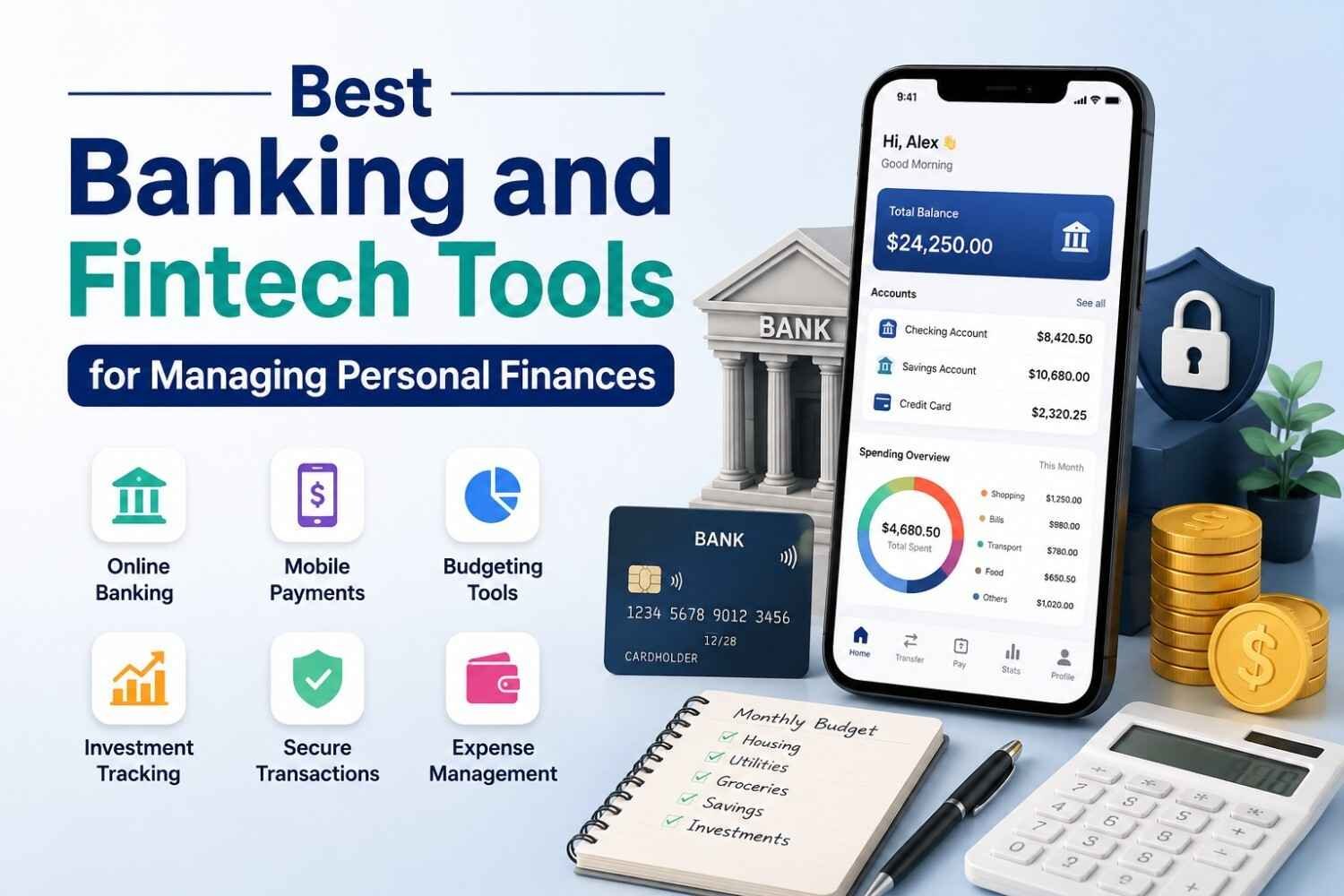
Managing personal finances has become easier with modern banking and fintech tools. From digital banking apps and budgeting platforms to automated savings and financial planning software, consumers now have more options for managing money efficiently.
The right financial technology can help you track spending, monitor accounts, create budgets, automate savings, and make better financial decisions. For people looking to improve their financial organization, choosing the right personal finance tools can make a significant difference.
What Are Banking and Fintech Tools?
Banking and fintech tools are digital services designed to simplify financial activities. They can include digital banking platforms, budgeting apps, financial management software, investment tools, payment services, and savings platforms.
Traditional banking typically focuses on services such as checking accounts, savings accounts, loans, and payments. Fintech platforms often build additional technology around these services to provide features such as automated budgeting, expense tracking, financial insights, and personalized recommendations.
Depending on the platform, users may be able to connect multiple financial accounts and manage their finances from one dashboard.
Best Types of Banking and Fintech Tools
There isn’t one financial app that works best for everyone. Different tools are designed for different financial goals.
1. Digital Banking Tools
Digital banking platforms allow users to manage everyday banking activities through websites and mobile applications.
Common features can include:
- Checking and savings account management
- Mobile deposits
- Bill payments
- Money transfers
- Transaction notifications
- Account statements
- Card management
- Security alerts
Digital banking can be particularly useful for people who prefer managing their finances without visiting a physical bank branch. When comparing digital banking services, look at account fees, interest rates, ATM access, security features, customer support, and available financial products.
2. Budgeting and Expense Tracking Tools
A budgeting tool can help users understand where their money is going each month. Many personal finance apps allow users to categorize expenses into areas such as housing, transportation, food, utilities, entertainment, subscriptions, shopping, and savings.
Expense tracking can make it easier to identify unnecessary spending and establish realistic monthly budgets. Some budgeting platforms also provide spending alerts and financial summaries, helping users stay aware of their financial activity.
3. Automated Savings Tools
Saving money consistently can be difficult when it requires manual transfers every month. Automated savings tools can simplify this process.
Depending on the provider, users may be able to schedule recurring transfers from a checking account to a savings account. Some financial platforms also provide features that help users create separate savings goals for emergency funds, travel, home purchases, education, large purchases, and retirement.
Before using an automated savings service, review its fees, account requirements, transfer rules, and security policies.
4. Financial Planning Tools
Financial planning software can help people organize their finances around longer-term goals. A financial planning tool may allow users to track income, expenses, savings, investments, debt, retirement goals, and net worth.
These tools can be particularly useful for people who want a broader view of their financial position rather than simply tracking monthly expenses. For more complex financial decisions, however, software should not be considered a substitute for personalized advice from a qualified financial professional.
5. Investment Tracking Tools
Investment management and portfolio tracking tools can help users monitor their investments in one place.
Depending on the platform, features may include portfolio tracking, asset allocation, performance reports, investment calculators, market information, and portfolio analysis.
Some platforms are designed specifically for investors, while others combine banking, budgeting, and investment tracking features. When evaluating an investment platform, consider account fees, available investments, security, educational resources, and the level of control provided to the user.
6. Credit Monitoring Tools
Credit monitoring is another important part of personal financial management. Credit monitoring tools can help users keep track of changes to their credit profile and identify potentially suspicious activity.
Depending on the service, features may include credit score access, credit report monitoring, account alerts, identity monitoring, and credit score updates.
It’s important to understand whether a service provides a credit score, a full credit report, or simply monitoring notifications, because these are different services.
7. Financial Calculators
Financial calculators are simple but powerful money management tools. Common calculators include loan payment calculators, mortgage calculators, savings calculators, compound interest calculators, retirement calculators, investment return calculators, and debt payoff calculators.
For example, a mortgage calculator can help estimate monthly payments based on loan amount, interest rate, and repayment period. Similarly, a compound interest calculator can demonstrate how regular savings may grow over time.
What Should You Look for in a Fintech Tool?
With hundreds of financial technology products available, comparing features before choosing a service is important.
Security
Financial applications may handle highly sensitive information. Look for strong authentication, encryption, account alerts, and established security practices.
Fees
Check for monthly account fees, transaction fees, transfer fees, ATM fees, subscription charges, and other costs. A tool that appears inexpensive may have additional charges depending on how it is used.
Account Integration
If you want to manage multiple accounts in one place, check whether the platform supports the banks and financial institutions you use.
Automation
Automation can save time. Features such as recurring transfers, bill reminders, spending alerts, and automatic categorization can make financial management easier.
User Experience
A complicated financial dashboard can make money management frustrating. Look for platforms with clear navigation, understandable reports, and useful notifications.
Privacy
Before connecting financial accounts, review how the provider collects, stores, and uses your financial information.
Banking Tools vs. Fintech Tools
Although the terms are sometimes used together, banking and fintech tools aren’t exactly the same.
| Banking Tools | Fintech Tools |
|---|---|
| Checking accounts | Budgeting software |
| Savings accounts | Expense tracking |
| Money transfers | Financial planning |
| Debit cards | Investment tracking |
| Bill payments | Automated savings |
| Bank statements | Financial analytics |
Traditional banks increasingly offer fintech-style features, while fintech companies may provide services that complement traditional banking. The distinction can therefore become less obvious as financial institutions continue to adopt new technology.
How to Choose the Right Personal Finance Tool
The best tool depends on your financial goals.
If your primary goal is controlling spending, a budgeting and expense tracking platform may be the best option. If you’re focused on building an emergency fund, an automated savings solution may be more useful. If you’re preparing for retirement, a retirement calculator and financial planning platform could provide more relevant features.
For people who want everything in one place, a comprehensive personal financial management platform may be worth considering.
Before signing up, compare:
- Features
- Fees
- Security
- Account compatibility
- Automation options
- Customer support
- Privacy policies
- Availability in your country
Final Thoughts
Modern banking and fintech tools can make personal financial management significantly more convenient. Whether you want to track expenses, build savings, monitor credit, manage investments, or plan for retirement, there are digital tools designed for almost every financial goal.
The best approach is to choose tools based on your specific needs rather than simply selecting the platform with the largest number of features.
For everyday money management, a combination of digital banking, budgeting software, automated savings, financial calculators, and credit monitoring tools can provide a useful foundation for organizing your finances.